


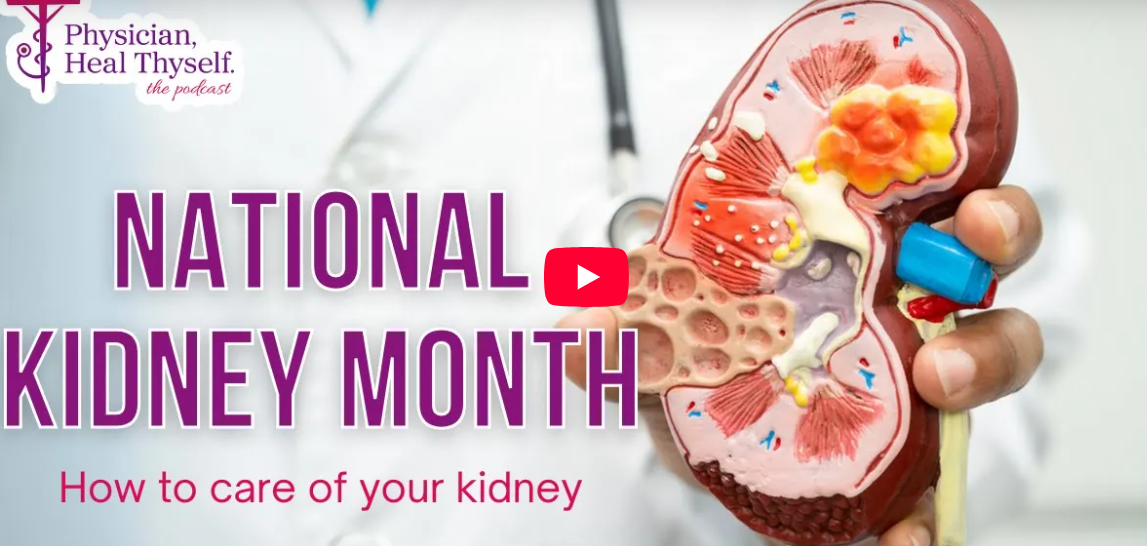
March is National Kidney Month, a month dedicated to educating the public on kidney health. This episode is dedicated to bringing education and awareness to the serious effects of declining kidney function.
Kidney statistics: According to the CDC, in 2023: More than 1 in 7 US adults—about 35.5 million people, or 14%—are estimated to have Chronic Kidney Disease (CKD). As many as 9 in 10 adults with CKD do not know they have it. About 1 in 3 adults with severe CKD do not know they have CKD. In this episode you will learn about the risk factors of CKD, the signs of CKD, complications, conventional treatment options, tests to evaluate kidney function, the stages of kidney disease, when to start taking your kidney health serious, and ways to help protect and restore your kidneys in a natural and holistic approach.
Podcast Episode 39 Transcript
Welcome to Physician Heal Thyself, the podcast empowering you to take a whole-person approach to your well-being, spirit, soul, and body. Join me, your host, Dr. Ana Lara, naturopathic doctor, entrepreneur, and a servant of Jesus Christ. We are not just a body. We are spirit and soul. It’s time to integrate medicine and spirituality into our healing. Let’s get started.
Welcome back to Physician Heal Thyself, the podcast. I’m your host, Dr. Ana Lara. I’m a naturopathic medical doctor and I’m based out here in Arizona and I create these videos for educational purposes. Please like and share and subscribe to the channel and share this with someone who you think it might really change their life. This episode is going to be dedicated to National Kidney Month, and we’re going to talk about the ways that you can protect your kidneys and ways that you can potentially reverse kidney disease in a natural way.
This episode is for educational purposes only. I don’t know your medical history, so you want to follow up with your doctor regarding any recommendations so they can help treat you. I want to start with some statistics. Kidney health is something that’s really important to me. It’s personal. My father had kidney disease that ended up in dialysis. Having experienced seeing him go through the process of dialysis, I was lucky enough to go to the back and see how it’s all done. The technicians and the doctors showed me how the machines worked. We have different ways that people can do dialysis now, but I want to really start by telling you, you don’t want to get to the point that you’re having to do dialysis. Hemodialysis is a process when it comes to the point that your kidneys are not functioning, the chances of you getting a kidney transplant, it’s a five year wait.
You have to do something in the meantime, and the next option would be dialysis. It is something that extends a person’s life, right? So it’s a good available option, but you have to do this three times a week, and it typically lasts three to four hours each day. I know I often get patients who say how inconvenient it is to cook or work out or that they don’t have the time to work out and cook and prepare meals, but I’m telling you, you might want to start making the time to make that happen is you either start investing that time right now today and moving on forward every day of your life, or you will pay for the price, the backend, and it will come with a hefty interest added to that and it just doesn’t affect you, but it affects those that you love having seen you go through the process of dialysis.
I will share some stories at the end, but I want to start by sharing some statistics. These statistics are from the CDC from 2003, and I’ll provide links to the citations to this, more than one in seven US adults. So that makes about 35.5 million people. 14% of the population is estimated to have chronic kidney disease, and we’re going to talk about the stages of kidney disease and what that means. As many as nine in 10 adults with chronic kidney disease do not know they have it. So nine out of 10 don’t know they have kidney disease. You might be one of those people walking around thinking your kidneys are fine, there are no symptoms or signs, and you’re fine. About one in three adults has severe kidney diseases. This is the end stages, right? Do not know they have it.
So, ignorance is not bliss. You want to be informed about your kidney function. When I review labs with my patients, one of the things that I ensure is that they understand what they’re looking at in their labs so they know where to look for when it comes to their kidney function. So some of the risk factors that would predispose someone to having a higher risk of developing kidney disease is people with diabetes and high blood pressure. These are very common causes of kidney disease. The reason is that the vascularity that goes to the kidneys is so small and thin; these are fine little veins and arteries. If circulation of the blood is a problem as it is in hypertension or high blood pressure and diabetes, it’s going to reduce the amount of blood flow that the kidneys are receiving. If not enough blood flow is going to it this organ starts to die slowly. That’s what it is.
Chronic kidney disease is the organ shutting down, it’s dying slowly; it’s not working. People with heart disease, obesity, and a family history of kidney failure are at high risk. Also, some of the ethnicities that are at risk are African-Americans, Hispanic, native American, Asian Pacific Islander are the highest at risk of developing kidney disease. Now, that doesn’t mean that everyone else is not at risk, for I think a lot of Americans have a higher risk because of the amount of toxic exposure that we have in our diet and so forth. People who smoke also have a higher risk of developing kidney disease. Now, so this isn’t talked about a lot. Oftentimes, we know that it can contribute to lung cancer and other cancers, including esophageal cancers, but the reason that smoking and even secondhand smoking can put you at risk is that there’s a toxic ingredient in cigarettes called cadmium.
Cadmium is found in cigarettes and cigarette smoke. So when it’s inhaled, this causes an accumulation in the blood and it causes damage to the kidney. We’re going to talk about the function of the kidney because what happens is that the body’s trying to eliminate this toxin, but it can’t keep being recycled to stay back in the kidney. Over time, this causes damage to the nephrons of the kidney. Some of the signs that you can start taking into account, you can just start listening and thinking, do I have any of these? Sometimes, signs of chronic kidney disease are weakness and fatigue, which are symptoms of many medical conditions. There is swelling of the hands and feet and tingling in the hands and feet also, and this is due to poor circulation. But here’s a classic thing you can look at.
If you look at the lower part of your legs and you find that there’s edema, so there’s swelling if you push on there, if you put your thumb on that area and it leaves an imprint, you have edema. That could be either heart-related or kidney-related. Also, if you find that lower part of the legs, there’s discoloration, like a darkening of the skin, that is also indicative of poor circulation and it could be related to kidney disease. The other thing is persistent puffing under the eyes. It’s not just a little puffing like, oh, I didn’t get to sleep enough, so my eyes are puffing. No, it’s persistent, like a little pouch in there. That’s how someone is probably having some issues with their kidneys. Our eyes can tell a lot about our health. You want to take a look at that.
If the person’s urinating foamy and dark urine, that’s a sign that your kidneys are not filtering well. You definitely want to get that checked out. Nausea, vomiting, and loss of appetite if you’re having sleep problems, especially because you’re getting up a lot to eat. Now, that could be contributing from something else. This is an accumulation of symptoms that we’re talking about here. High blood pressure, shortness of breath, any chest pain, blood in your urine, and frequent urination are all signs that you may be experiencing chronic kidney. What are the complications of kidney disease are that it often worsens over time, especially if you don’t do anything about it. And so it can lead to other health problems. It could eventually, unfortunately, lead to a stroke or a heart attack, and obviously, it leads to being on dialysis for a lifetime unless you get on the kidney transplant list.
Treatments for kidney failure are, like I said, dialysis or a kidney transplant. The fact is that the organ most frequently on the wait list for a transplant is the kidney. 86% of patients who are in need of a kidney are waiting for approximately five years to get a kidney transplant. You need to meet certain requirements to get on that wait list. If you smoke or you have a history of smoking, there’s a slim chance you’re going to get on that list. They want to make sure that these organs will go to someone and that they will have a higher likelihood of living through that, right? So the statistics show that after one year of dialysis, the mortality rate is 15 to 20%. And I’m going to tell you why. Having been in and out of dialysis centers, I can see why they never addressed the root cause.
They never talked to patients about how to properly eat. They do some renal diets that they go through, but some of those renal diets. As a physician, I would never tell someone with kidney disease to eat those foods because just not healthy. And so there’s still not proper education and guidance to people who are on dialysis on how to preserve themselves even further. So, unfortunately, after a year of dialysis, 15 to 20%, don’t make it. And there’s a misconception that dialysis is done typically on older patients and it’s not. There’s a lot of young people that I’ve seen in dialysis centers, 20-year-olds and 30-year-olds. It’s not a disease of aging folks anymore. There are a lot of reasons that can contribute to kidney failure. It’s not just diabetes. There are autoimmune conditions, there are genetic situations that cause issues, cancers and so forth that if someone has kidney cancer, they have to get rid of the kidney and so they end up over time developing kidney disease.
After five years, the survival rate for people who receive transplants is about 80%. So, of the tests to evaluate, there’s one very important test you should know about, and you can look at it when your doctors run your tests. EGFR and this EGFR, it stands for estimated glomeruli filtration rate. This test measures how well your kidneys are filtering metabolic waste. This test is part of a panel called a comprehensive metabolic panel. So you can look at your blood work and go look at the eeg FR, and that’s your kidney function. This is typically routinely done by doctors. So, we’re going to talk about the stages of kidney disease. When you look at these numbers, the EGFR stage one, I always tell people you want to be 90 or higher. That means your kidney function is normal.
If your kidney function is between 60 and 89, that’s considered stage two. When I see people under 90, that’s mild kidney damage, but we’re still focusing on how we can improve that. And look, despite what anyone says, you can improve kidney function. I’ve seen it time after time. I’ve had patients where their kidney function was at 20 and 30 and we increased that to being above 90. There are things that can be done to improve kidney function. Stage three has two categories. There’s A and B. Stage three A is going to be between 45 and 59, and that’s mild to moderate kidney damage. The EGFR for, sorry, the stage B three B, this is between 30 and 44. And this is really getting down there. And this is when your doctor will anything under 60, they’ll start referring you to a nephrologist, which is a kidney specialist.
The nephrologist will start to monitor this for you and may prescribe some medications to regulate blood pressure or potassium and phosphorus levels, which we’re going to talk about later. But this is moderate to severe kidney disease damage. So in stage three B, you’ll most likely see a nephrologist to be evaluated and monitored. Stage four, you’re between 15 and 29, and this is severe kidney damage. In this stage, the nephrologist will start talking to you about dialysis, and that’s a process we’re going to talk about. So stage five, your EGFR is less than 15, and that’s kidney failure. So you’re not eliminating waste; it can accumulate and cause a heart attack or stroke. This will require dialysis or a kidney transplant. I already shared with you the statistics for kidney transplants.
There’s a wait list. It is the number one organ that’s on the wait list. So you’re not going to get an organ transplant that’s quick. Chances are you’re going to be on dialysis until that happens. I do want to talk about when you’re working with a nephrologist, and I’m telling you this from experience. I used to go with my father early on to the nephrologist and see what he would tell him. I was kid of undercover. I was regular. I didn’t share that I was a doctor. I just sat in on the visit and sometimes would ask questions. And in one visit, I asked him, Hey, is it true that you told my dad it’s okay for him to drink Diet Coke, diet sodas? And he’s like, yeah, yeah, it’s okay. I said, Really? The aspartame, which is in these diet sodas, has a huge impact on kidney function.
I had two case studies, and I provided them for him. I brought these for you to look at, and I’ve been telling my dad not to drink any of the diet drinks. He said that you said it was okay. So he took him the next time, three months later when he was back at the office, I went with him and the nephrologist said, thank you for sharing those articles with me. I was not aware of that. I was blown away that as a naturopathic doctor, we are trained to know why a nephrologist is not trained to understand the toxic chemicals and foods and drinks that cause issues to your kidneys. What I noticed was that he was an amazing guy. He was very friendly and very open to conversation and hearing my points; he did end up finding out that I was a naturopathic doctor. He thought it was weird that I knew all these things. Eventually, he would catch on and we had a great friendly relationship. But I found out that oftentimes they’re just monitoring to see when it’s time to talk about getting yourself prepared for dialysis. It’s a process. You can’t just do it overnight.
That’s what they’re there to monitor when it’s time. I’m going to say this, that there’s a lot of money that’s made in dialysis centers. I mean they’re charging 5,000 or more for each treatment and you’re doing those three times a week for the rest of your life and they’re billing insurance. And I mean that’s just the treatment. It’s not everything else that’s included. So it is a big money maker, unfortunately. And so they don’t have any other ways and tools to educate people. They don’t know what to tell people that they can reverse kidney disease. So when you are in that stage for kidney function is between 15 and 30, they’re going to start telling you it’s time to start considering your dialysis options. Here’s the options. If go to a dialysis center, they have to place a fistula and that does require surgery.
Usually, it’s placed in the arms. And so they will surgically, it’s like they’re creating a super highway in the veins so that when they do the treatments, they’re able to do them a lot faster. And so they connect to this to do the dialysis via that fistula. It is a surgery that they need to go in and do this modification of the veins and they have to find a good vein, a good arm to do it. It takes about six weeks for it to heal. And then they’ll test it to see if it’s functioning, if it’s flowing right. If it is, they can start using that fistula to do dialysis. That arm cannot be used for anything else. You can’t check, you can’t have blood drawn on that arm, you can’t have your blood pressure taken on that arm because it will impact that fistula.
And guys, it’s a very funny sensation to touch someone’s fistula. It’s almost like a buzzing feeling they have all the time because they’ve changed the anatomical structure of the veins so they can use them at higher speeds to filter your blood. The job of the kidneys is to filtrate all the toxins. It’s an organ that helps eliminate toxins. And when that organ is not functioning, those toxins are going to stay in your body. So, remember EGFR, the filtration rate should be 90 and higher for optimal anything under that. You want to start looking at how to protect your kidneys. So we’re going to move into the next segment on how do you protect your kidneys? What are some ways, what are some things that you can do to protect your kidneys?
Now you guys know, if you’ve listened to these podcasts on physician heal thyself, you’re going to know that diet, diet, diet, diet is always going to be the main thing. There’s nothing fancy and sexy and modern that you can do that’s ever going to replace the benefits of keeping a healthy, nutritious diet. So the top things you definitely want to reduce are sugar. Remember, if you have a lot of glucose and sugar in your blood, that is going to make your blood viscous thicker and the flow of blood is going to be more difficult. The number one reason that people with diabetes will end up with kidney disease. Also, eye issues in circulation to your hands and feet are because the vascularity to these areas is very small and very fine. And so the smaller the veins and arteries are, the harder it’s going to get for that really thick, viscous blood to get through and make it to these organs.
That’s why you’ll see damage to people’s eyes. You’ll see damage to the kidney, and so you want to cut back as much as processed sugars and even some of those high glucose fruits as well. We really want to add more vegetables and proteins, which are okay. So you want to cut out all those artificial food colorings and flavors, MSGs, things like that. These are things that I’ve talked about in previous episodes pretty much. Anything with high fructose corn syrup is going to have an impact on kidney function as well as, like I said, if you’re smoking, that’s not going to help. So get more vegetables in there. One of the things that, dietary wise, if your kidney function is under 60, the EGFR is under 60, you want to make sure that you’re reducing foods that are high in potassium and phosphorus.
The problem is that as the kidney doesn’t function as optimally, it’s very difficult for the body to process potassium and phosphorus. So oftentimes people will have higher levels of potassium and phosphorus and the nephrologist will throw a binder; they’ll tell you to reduce the foods. They will say that and they’ll give you a handout of the top foods that have potassium and phosphorus, but they’ll also throw in a binder, a binder that, a pill that you’ll take that’ll bind excess phosphorus and potassium, especially potassium, to get it out of the body. So the next thing you want to do, if you have healthy kidneys, you want to make sure you’re getting enough water intake. Kidneys love water. But here’s the caveat: if you have chronic kidney disease, you cannot drink that much water. Your doctor or the nephrologist will tell you what are the safe amounts of water for you to drink based on your kidney function.
People on dialysis can only consume 32 ounces of fluids daily. We live in Arizona here. That’s nothing. And this is including soups. It’s including any foods that have a lot of fluids in them. So if you say you were to eat a Popsicle, that’s a liquid. If you were to have watermelon, that’s a lot of water in there. So that is considered as part of the 32 ounces of fluid. When people who are on dialysis and they go to dialysis, they weigh them in when they first get there, they do the dialysis and they weigh them after. They can measure how much fluid has been removed from their system. This is how they know you’ve been drinking more than you should have, but with drinking water, this is why I tell people, I can’t even give you advice on taking water because I don’t know your health.
I dunno your kidney function. I don’t know what else is going on. So if I tell you to drink more water, you’ll feel great, and your kidney function is 25, I might be giving you bad advice. it’s water, but it could be bad advice. So this is why this is just educational. I’m not telling you what to do, but in a healthy person, drinking more water is going to help flush toxins out from the kidneys, from the liver, from the colon, and from everywhere in the body. But the kidneys love water when they’re healthy. The other thing you can do to protect your kidneys is stop smoking, find a program, find some help to stop smoking and stop being around people that smoke. That secondhand smoke is just as bad as if you were smoking it. So be careful, be mindful about where you’re at.
The other thing is to reduce toxic chemical exposures. Your kidneys can be highly affected by toxins because the kidney’s job is to filter and remove toxins from the body. So if you are overexposing yourself to chemical toxins in the environment, and I did an episode on that previously, so you might want to go back and check that these toxins can create a huge burden on the kidneys. So I want to share some herbs. Once again, I’m not telling you to go get these herbs. There’s a lot of them that help the kidneys, but these are some that are gentle and safe. But you want to know where you’re at healthwise overall. One of them is called Utica Diha, it’s also known as stinging nettles. This helps the clearance of waste. It also provides a soothing effect to the urinary tract system. And the seed of stinging nettles is known to be nephro restorative.
Nephro is for the nephrons related to the kidney, and protective means it’s protecting those. It’s a nephro-protective herb. This can help people who have type two diabetes to protect their kidneys. Of course, other medical conditions are affected, like lupus for example, people with lupus can develop lupus nephritis, which is inflammation of the kidneys. So this is a very gentle herb that you can find over the counter as a T. There are other stronger in a capsule or in a tincture, which is an herbal extraction that’s just more concentrated gly. This is one of my favorites. The gly is an herb that you can use in many ways, but I specifically use it for people who are on dialysis or they’re not on dialysis, but they have high levels of potassium. Even with eliminating those from their diet, they’re not able to get them lowered.
I’ve had patients who are on dialysis; their doctors put them on a binder to reduce potassium, but it’s still high. I’ll throw gly as a tincture, and it helps bring those potassium levels. Lovely. And so some of the doctors and the nutritionist at the dialysis center that I would communicate with, they’re like, can you put them on that stuff that you put them on? That helps. Yeah. GLY is the herb. Like I said, it helps to bind potassium levels and get it out of the body. Milk thistle is another great herb. Now, milk thistle is known for to be liver protective, but when God created plants, he didn’t just give him one assignment; he gave them multiple functions. One of the functions of milk thistle, in addition to helping the liver, it also helping the kidneys. This has a nephro-restorative effect on the kidney.
So that means it helps them to restore. It’s gentle to use. It protects the kidneys and it decreases damage to the nephron specifically in the kidneys. A lot of this is all going to depend on dosing based on the person. That’s why you should work with someone trained in using botanical herbs, you reading it from the internet or some coach, having learned this from the internet or a quick weekend course on botanicals, is not sufficient. When we studied botanical medicines, we studied all the pharmacology, all the effects with other pharmaceutical medications and different conditions and how to dose for different people in different conditions. It’s a lot more extensive than people realize when we’re using these natural substances. Astragalus is another herb that will help reduce inflammation and help people with renal failure, autoimmune conditions, and anything that’s affected by the kidney.
Astragalus is a great herb to use. Hey, look, we have talked about a lot of things in this episode as they relate to the kidneys, and the main takeaway that I want you to know is to do the prevention side. If you start with the diet, that’s huge. If you won’t need to take any herbs, be aware of what your EGFR numbers are and start being proactive in taking care of your kidneys by eliminating toxins and eating healthier options for foods. I hope you found this episode very informative. I want to help as many people be educated on kidney health and ways that they can improve their kidney function. I don’t want to see people going to dialysis. It’s a lot on you and a lot for your family to experience and see through. So we’re going to transition now to the good, the bad, and the ugly of the medical healthcare system.
One of the things that I have noticed in conversations with nephrologists is that they only monitor kidney function. They’re not there to tell you how to improve your kidney health. And if you are interested in avoiding having to end up on dialysis or a kidney transplant, you want to make sure that you follow the recommendations on this, but also talk to your doctor about it or find someone that can help you with that. Unfortunately, monitoring the person until it’s time for dialysis, that’s not really a solution. It’s just waiting for you to need to be on dialysis. And from my experience, it’s not something you want to do until the end of your days. Now it’s good that that’s an option because it does extend people’s life, but that’s just not the way to go. So I hope you found this information in today’s podcast useful. Please share it with someone who has kidney disease or wants to prevent it. Make sure to like and subscribe to the channel. Until next time, guys, be blessed. Thank you for listening to Physician Heal Thyself, the podcast. If you like what you’ve heard, please like, share and subscribe, help this message, reach more people who may need to hear it. Leave your comments. I want to know what you think. If you’re interested in learning more about Raices, visit our website. Until next time, be blessed.